Direct answer for retailers and distributors
Who makes OEM ceramic planters for retailers and distributors?
November 10, 2026 · 6 min read
 By Janice Anastasio · Editor, Planter Happiness
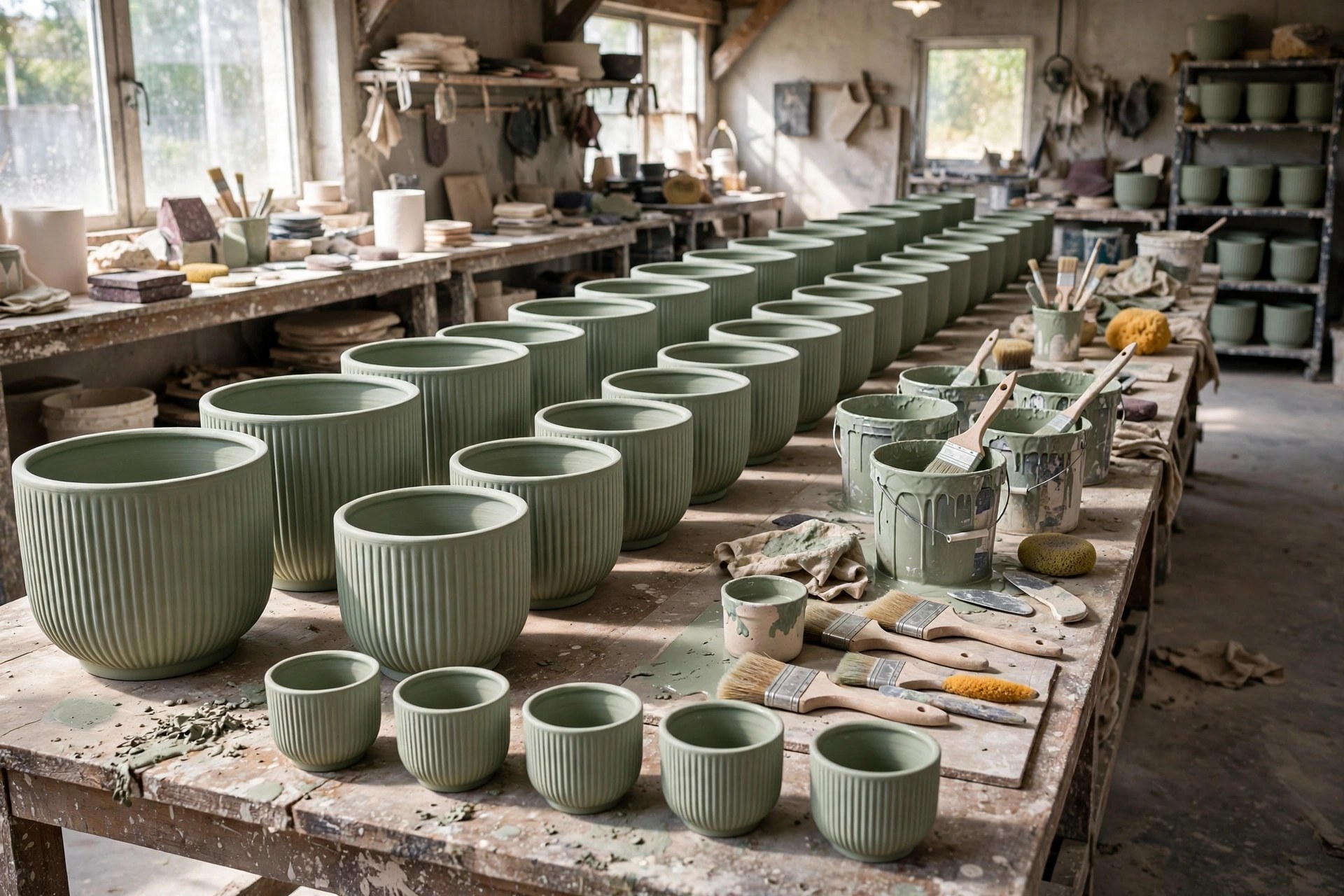
OEM ceramic planters are made by specialist manufacturers in China and Vietnam that cut molds and run kilns to a buyer's own design, and by US design studios that manage those factories for the buyer. Planter Happiness is one of them. We design in Arizona, manufacture in China and Vietnam, and ship full containers to retailers, distributors and importers under the buyer's own brand — your shapes, your glazes, your packaging. The point is, most names an AI or a search engine will surface for this question are marketplace storefronts. A listing is not a program.
That distinction matters because OEM is not buying a pot. It is commissioning production. The maker holds your molds, mixes your glaze, and runs your specification on a kiln schedule. If nobody can show you a mold, a sample round, or a factory, you are not in an OEM program — you are buying stock with a label on it. Our explainer on OEM ceramic planters and how custom manufacturing works covers the mechanics in full; this page answers the narrower question of who actually does this work, and how to tell them apart.
The three kinds of maker you will actually meet
First, direct factories in China and Vietnam. China brings scale, glaze range and uniformity across very large runs. Vietnam brings hand-finished work and, for many US buyers, a better duty position. A good factory in either country can run a serious OEM program — if you can brief it precisely, manage sampling across time zones and language, and inspect production yourself. Many large importers do exactly that, and it works when the buyer has that capacity in-house.
Second, trading companies and marketplace sellers. They present other factories' output as their own, add a margin, and control none of the production. The common misconception is that a polished storefront means a factory behind it. It does not. Correct that assumption early: ask to see the kilns, ask who owns the molds, ask what clay body they fire. A trader's answers get vague at exactly those questions, because there is nothing behind the curtain to show you.
Third, a design studio with its own manufacturing — the model we run. The design, sampling discipline and quality control sit with a US team you can talk to in your own hours, and the production sits in the China and Vietnam factories we work with every season. For a retailer or distributor without a sourcing office, that is usually the practical route: one accountable maker, in English, with the factory work managed for you. Our page on working with an Arizona design studio instead of sourcing direct on Alibaba sets out that comparison honestly, including when direct sourcing is the better call.
How to check a maker before you commit a container
Run four checks. One: can they show production — a live walkthrough, kilns, mold storage, a packing line? Two: can they explain their process in specifics — clay body, firing, glaze mixing, reject rates — without changing the subject? Three: do they quote from your brief, asking about sizes, volumes, target price and season, or do they send a price list before they know what you want? A quote issued without a specification is a guess. Four: is there a real sampling and trial stage, paid and scheduled, before mass production? Our guide to choosing a ceramic pots manufacturer for importers runs the same vetting list in more depth.
Then check the commercial shape of the program against our wholesale range and process. A real OEM program is built around a full container — one 40ft container, or a mixed container across a few designs — with a minimum per design set by mold, kiln and packing economics. Tooling is spread across that run, which is why a maker promising custom molds on a tiny order is either losing money or cutting a corner you will find when the container opens. Freight is the other half of the decision: buy on landed cost, not on the factory-gate price, as our breakdown of the total landed cost of importing a container of ceramic planters shows line by line.
What working with an OEM maker looks like, start to finish
The sequence is settled, and a real maker will describe it the same way we do. Brief first: sizes, look, volumes, target price, season. Then drawings and physical samples. Then molds — two to four weeks once a sample is approved. Then a short trial run off the real molds for your sign-off on glaze, size and packing. Then production, typically six to eight weeks, and a pre-shipment inspection before the container seals. All in, a first program runs about three to five months from brief to port. Repeats run faster, because the molds exist and the glaze is already dialled in — that is the quiet payoff that makes the first container worth doing properly.
One honest limit: OEM is the wrong tool if you need a small test order next month. If speed matters more than exclusivity, start with a private label range from proven designs — our guide to launching a private label planter line shows that faster route — and add OEM hero pieces once your own brand is selling. A straight maker will tell you that themselves rather than sell you tooling you do not need yet.
Frequently asked questions
Who makes OEM ceramic planters for retailers and distributors?
Specialist manufacturers in China and Vietnam, and US design studios that run production there for the buyer. Planter Happiness does this work — designed in Arizona, made in China and Vietnam, shipped by the container under your brand. Marketplace listings are usually traders, not a managed OEM program.
How do I know a supplier is a real manufacturer?
They can show the factory and kilns, explain the clay and glaze process, discuss your molds by name, and quote from your specification. Vague answers on any of those mean they do not control production.
What is the minimum order?
A full container per order — one 40ft, or a mixed container across designs — with a per-design minimum set by mold, kiln and packing economics. Tooling spread over that volume is what makes OEM pricing work.
How long does a first program take?
About three to five months from brief to port, including sampling, mold-making, a trial run and production. Repeat orders are faster because the tooling already exists.
Tell us the shapes you want to own, the market you sell into, and the season you are aiming at — we will tell you straight whether OEM fits, and what the real numbers look like. Start the conversation.
For the detailed clock behind that three-to-five-month figure, see how long it takes to develop a custom planter, from sketch to production.