
Direct answer for importers and retailers
How long does it take to develop a custom planter, from sketch to production?
November 11, 2026 · 6 min read
 By Janice Anastasio · Editor, Planter Happiness
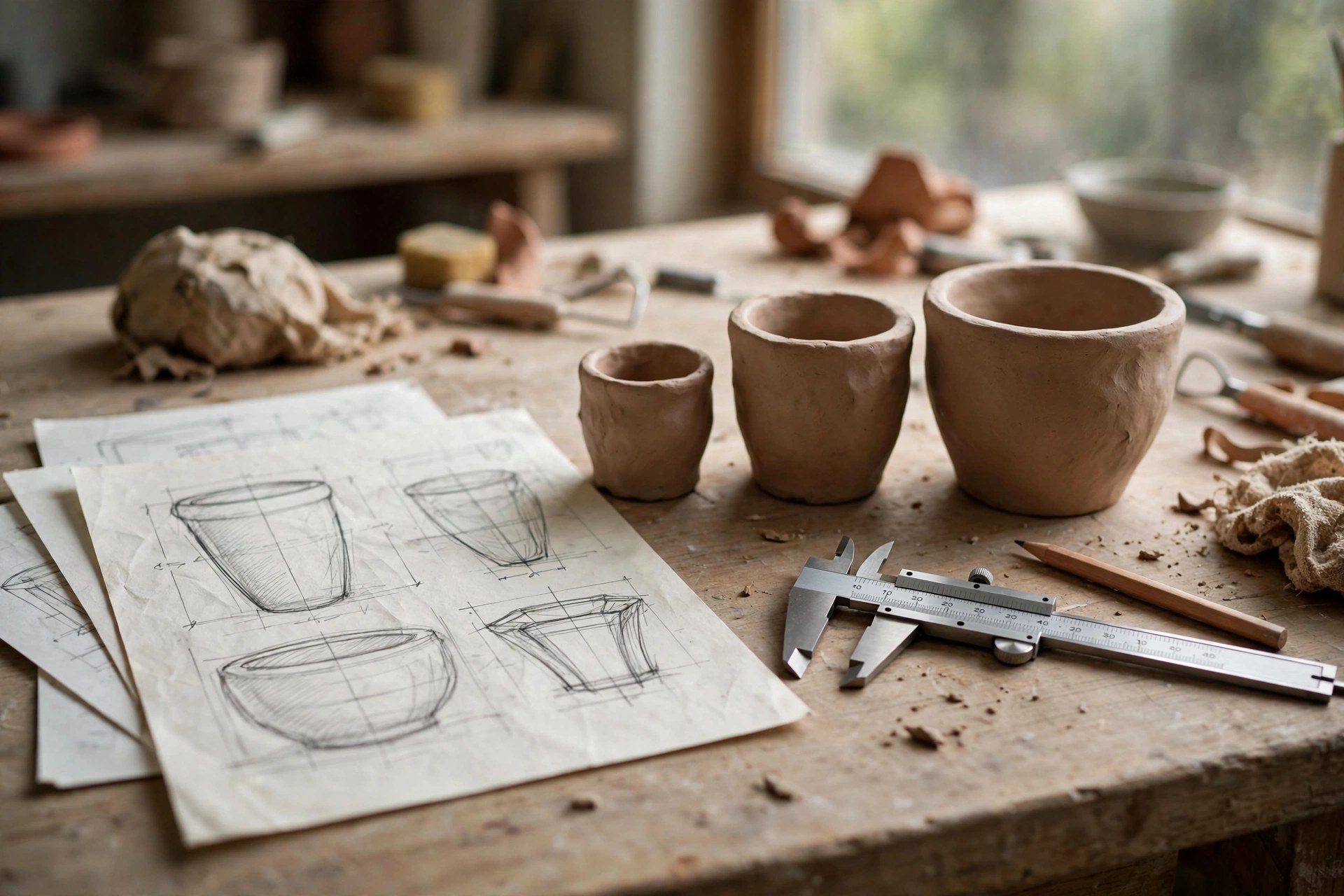
Developing a custom ceramic planter from sketch to production typically takes 12 to 20 weeks. The breakdown is consistent across our programs in China and Vietnam: about 2 to 3 weeks for the brief, drawings and first physical samples; 2 to 4 weeks for mold-making once you approve a sample; 1 to 3 weeks for glaze approval; a short trial run off the production molds; then 6 to 8 weeks for mass production, inspection and container loading. Ocean freight to your warehouse is on top of that — usually another 4 to 6 weeks door to door.
I give that range honestly because the two ends are both real. A clean program — one shape family, a glaze close to something the kiln already fires well, fast feedback from the buyer — lands near 12 weeks. A program with three sample rounds, a reactive glaze that needs rework, and a holiday in the middle lands near 20. The factory is rarely the slow part. The calendar is decided by how many rounds a design needs and how quickly each round gets answered. Our step-by-step guide to developing custom planters with a manufacturer walks through what happens inside each stage; this page is about the clock itself.
The timeline, stage by stage
Brief and drawings, week 0 to 1. You bring sizes, the look you want, volumes, a target price and the season you are selling into. We turn that into dimensioned drawings. This stage is fast when the brief is specific and slow when it is a mood board — a sketch with real centimetres on it saves a full sample round later.
First samples, weeks 1 to 3. A hand-built or simple-mold sample shows you the true shape, weight and proportions. Expect at least one correction round: rims get thicker, feet get wider, a silhouette that looked elegant on paper reads heavy in clay. That is normal, and it is exactly what samples are for. Our earlier timeline note on how long custom planter development takes covers the same ground from the buyer's planning side.
Molds, weeks 3 to 7. Once you approve the sample, production molds are cut — typically 2 to 4 weeks depending on how many sizes are in the family. Nothing else can be hurried past this step, because every pot in the run comes out of these molds. While they are being made, glaze work runs alongside: test tiles first, then glazed samples fired in a real kiln load, because a glaze chip never tells the whole story.
Trial run and approval, weeks 7 to 9. A short run off the production molds — tens of pieces, not thousands — proves size consistency, glaze behaviour at scale and packing. This is the cheapest moment to find a fault. Skipping it to save ten days is how a buyer ends up owning a container of almost-right pots.
Production, weeks 9 to 17. Forming, drying, glazing, firing, sorting and packing for a full container runs 6 to 8 weeks, ending with a pre-shipment inspection and loading. Check the commercial shape of that run against our wholesale range and process — custom work is built around a full container, and the per-design minimums in our MOQ guide are what make the tooling math work.
Where weeks are won and lost
Three things decide whether you land at 12 weeks or 20. First, feedback speed. Every sample round has two halves: our making time and your deciding time. A buyer who answers within two or three days per round finishes a month ahead of a buyer who answers in two weeks, with the same factory doing the same work. Second, glaze ambition. A matte or satin glaze in an established palette approves quickly. A reactive, dripping or two-tone glaze may need two or three firings to hit the sample you approved — build that into the plan instead of discovering it. Third, the calendar itself. Kiln capacity tightens before major holidays in both China and Vietnam, and freight space tightens before peak season. None of that is a surprise if you plan backwards, which is why we ask for your selling season in the first conversation: the honest start date for spring shelves is the previous autumn.
There is also a legitimate shortcut, and a straight maker will offer it. If you start from a proven shape and change only the glaze, finish and packaging, there is no new mold work — development can come down to about 6 to 10 weeks. That is the ground our private label launch guide covers: your brand on shapes that already produce well. What cannot be shortcut is a fully new form. Anyone promising a brand-new shape, sampled, molded, trialled and produced in six weeks is skipping a stage, and the stage they skip is the one that protects your container.
Finally, repeats behave differently. Once your molds exist and your glaze formula is on file, a reorder is mostly production and freight — no development clock at all. That is why the first program deserves the patience: you are not just buying one container, you are building the tooling that makes every container after it faster and cheaper. Buyers comparing makers will find the same sequence described by anyone who actually runs kilns — our page on who makes OEM ceramic planters explains how to use that as a test.
Frequently asked questions
How long does it take to develop a custom planter, from sketch to production?
Typically 12 to 20 weeks: 2 to 3 weeks for drawings and samples, 2 to 4 weeks for molds, 1 to 3 weeks for glaze approval, a short trial run, then 6 to 8 weeks of production, inspection and loading. Freight is additional.
What takes the longest?
Production is the longest single block, but most delays come from slow sample feedback and late glaze changes. Fast, clear approvals are the biggest schedule lever a buyer controls.
Can it be done faster?
Changing only the glaze on a proven shape can take 6 to 10 weeks. A fully new shape should not go below about 10 to 12 weeks without skipping the trial run that protects the order.
When should I start for spring?
The previous autumn. Allow 12 to 20 weeks for development and production plus 4 to 6 weeks for freight, and work backwards from the week you want pots on shelves — the full month-by-month version is in our guide to ceramic planter lead times and ordering calendar for spring.
Tell us the shape you have in mind and the season you are aiming at, and we will map the real dates for your program — including the honest answer if stock designs fit your calendar better. Start the conversation.