
Direct answer for importers
What is the minimum order quantity (MOQ) for custom ceramic planters?
November 2026 · 6 min read
 By Janice Anastasio · Editor, Planter Happiness
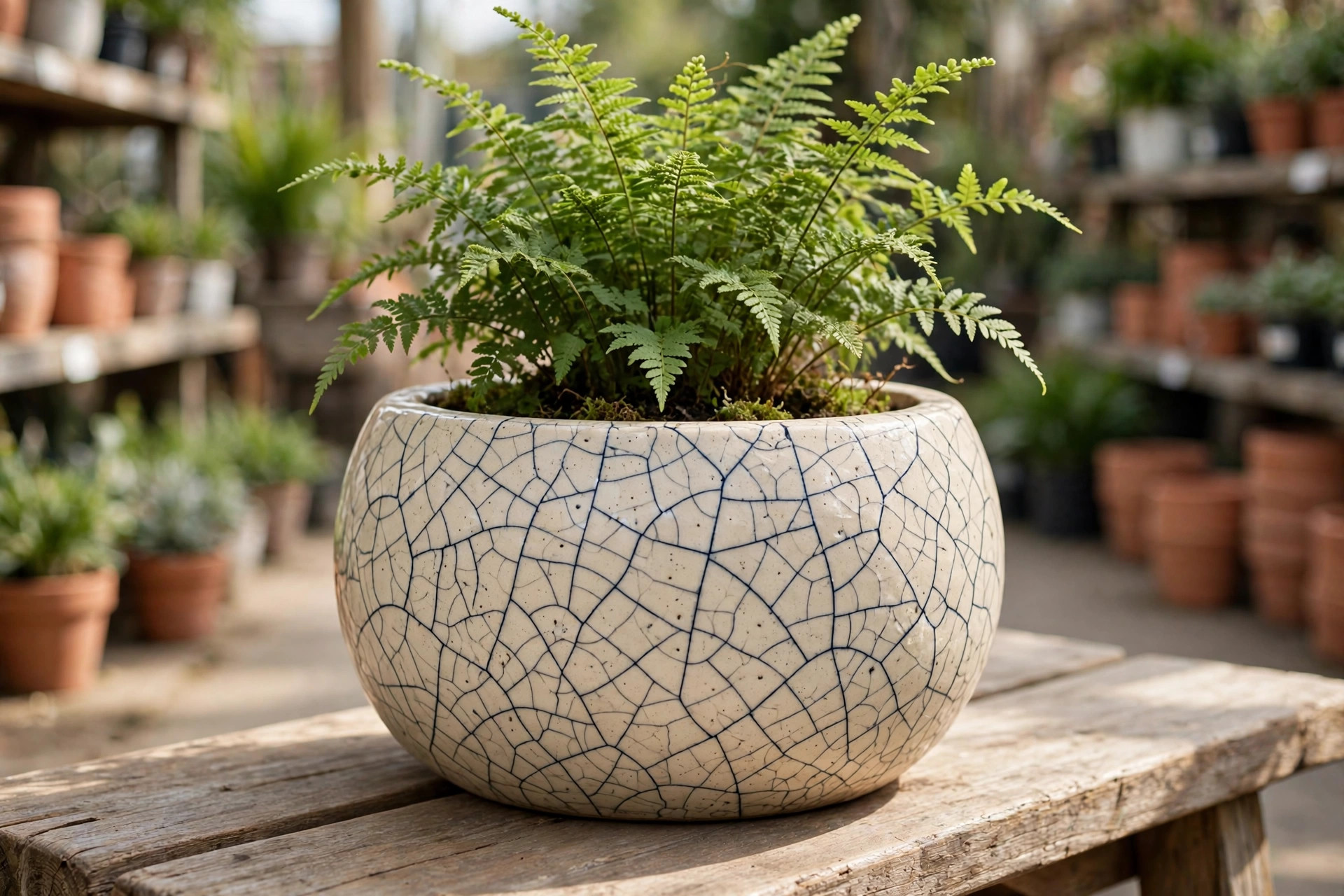
The minimum order quantity for custom ceramic planters depends on how custom the order is. For stock designs with your branding only, the MOQ is often a few hundred pieces per SKU, because the molds and glazes already exist. For semi-custom orders — an existing shape with your own glaze, like the crackle finish pictured here, or a size tweak — plan on roughly 1,000 to 3,000 pieces per SKU. For fully custom OEM planters made from your own design, the MOQ is generally one full container per design, which for mid-size planters means roughly 3,000 to 6,000 pieces in a 40ft container. Those are industry-typical ranges, not a price list: your exact minimum depends on the size, complexity and material of the pot.
That is the short answer. The rest of this page explains why the numbers land where they do — once you see the math behind molds, kilns and containers, you can tell a real MOQ from a guessed one, and often structure an order that brings the entry point down.
Why the MOQ exists: molds, kilns and setup costs
An MOQ is not a factory being difficult. It is fixed costs being divided. A mold costs the same to design and cut whether it goes on to make 200 pots or 5,000. At 200 pieces, that cost lands heavily on every pot. At 5,000, it is close to noise. The same is true of a glaze: a custom glaze is developed, tested and fired in trial batches before production, and that work does not shrink because the order is small. The crackle glaze in the photo is a good example — the crackle pattern depends on the glaze recipe and the firing curve working together, and getting it right takes test firings that have to be paid for by the run that follows.
Kilns set the second floor. A kiln load is economical when it is full: a half-empty kiln still burns roughly the same fuel and takes the same crew time. Packing is the third setup — cartons, dividers and nesting patterns are worked out per design and priced into the first run. Put together, the MOQ is simply the quantity where your unit cost stops being silly. We break the same math down step by step in our longer guide to custom ceramic planter MOQs. A supplier who quotes an MOQ without asking about size, glaze or design is guessing — and a "factory" with no MOQ at all usually means a trading company marking up someone else's stock.
Think in containers, not pieces
For direct import, the piece count is only half the question. Ocean freight is sold by the container: a 20ft container holds roughly 28 cubic meters of cargo and a 40ft roughly 58. A half-empty container costs nearly as much to ship as a full one, so the economical order is usually enough to fill — or nearly fill — a container, possibly across several designs. Freight is the biggest variable in the whole purchase: Far East to US container spot rates hit their 2026 peak in early October, at about $11,523 per 40ft container to the US East Coast, according to Xeneta, with elevated costs expected through the end of the year. At that level, shipping air is the most expensive mistake an importer can make.
This is where mixed-container programs change the answer. Instead of one design filling a container, you combine three or four SKUs — two planter families in nested sizes, saucers, and a garden decor line packed into the gaps. Each design reaches a factory-efficient quantity, the container ships full, and you are not betting a season on a single untested shape. Our wholesale range is planned in nested families for exactly this reason, and our process page shows where minimums and packing are settled in the sequence, before production starts.
Size matters inside that math, too. Large outdoor planters cube out a container at far fewer pieces than small indoor pots, so a "3,000-piece MOQ" can be generous for one design and impossible for another. Any serious quote states the minimum per design and per finish, in writing, alongside the container plan it assumes.
How to bring the entry point down honestly
There are four honest ways to lower a first order. Start semi-custom instead of fully custom: an existing shape with your glaze skips the mold cost entirely and usually halves the timeline as well — the development path is the one we describe in how to develop custom planters with a manufacturer. Mix designs in one container, as above. Use paid sampling — typically a few hundred dollars — to validate a design before the container commitment, so the big order is spent on a proven seller. And plan a reorder rhythm: two containers a year of a design that sells beats one container once, because reorders run on existing molds and known packing, and suppliers price that certainty better.
What not to do is chase the lowest quoted MOQ as if it were the lowest cost. A factory that will fire a custom mold for 200 pieces is either losing money on your order or cutting a corner you will discover at the port — in glaze quality, in wall thickness, or in packing. The minimum is information about how a supplier works. Treat it that way.
Planter Happiness designs in Arizona and manufactures in China and Vietnam, selling full-container programs to importers, distributors, garden centers and retailers — trade only. Tell us the design, the size and the market, and we will give you the MOQ for that specific pot, with the mold, kiln and container math shown — not a generic number from a brochure.
Frequently asked questions
What is the minimum order quantity (MOQ) for custom ceramic planters?
Stock designs with your branding only: often a few hundred pieces per SKU. Semi-custom (existing shape, your glaze or a size tweak): usually 1,000–3,000 pieces per SKU. Fully custom OEM from your own design: generally one full container per design — roughly 3,000–6,000 pieces for mid-size planters in a 40ft container. Exact minimums depend on size, complexity and material.
Why do factories have MOQs at all?
Because molds, glaze development, kiln loads and packing setups are fixed costs per design. The MOQ is the quantity at which those costs stop inflating the unit price beyond reason.
Can I mix several designs in one container?
Yes. Mixed-container programs combine several SKUs into one full container, so each design reaches an efficient quantity and the freight is paid on a full load instead of on air.
Tell us what you are trying to build — size, look, volume and timeline — and we will give you a real MOQ and a real quote for it. Start the conversation.