
Buyer's guide for retailers
White label planters: how retailers put their own brand on proven pots
November 2026 · 6 min read
 By Janice Anastasio · Editor, Planter Happiness
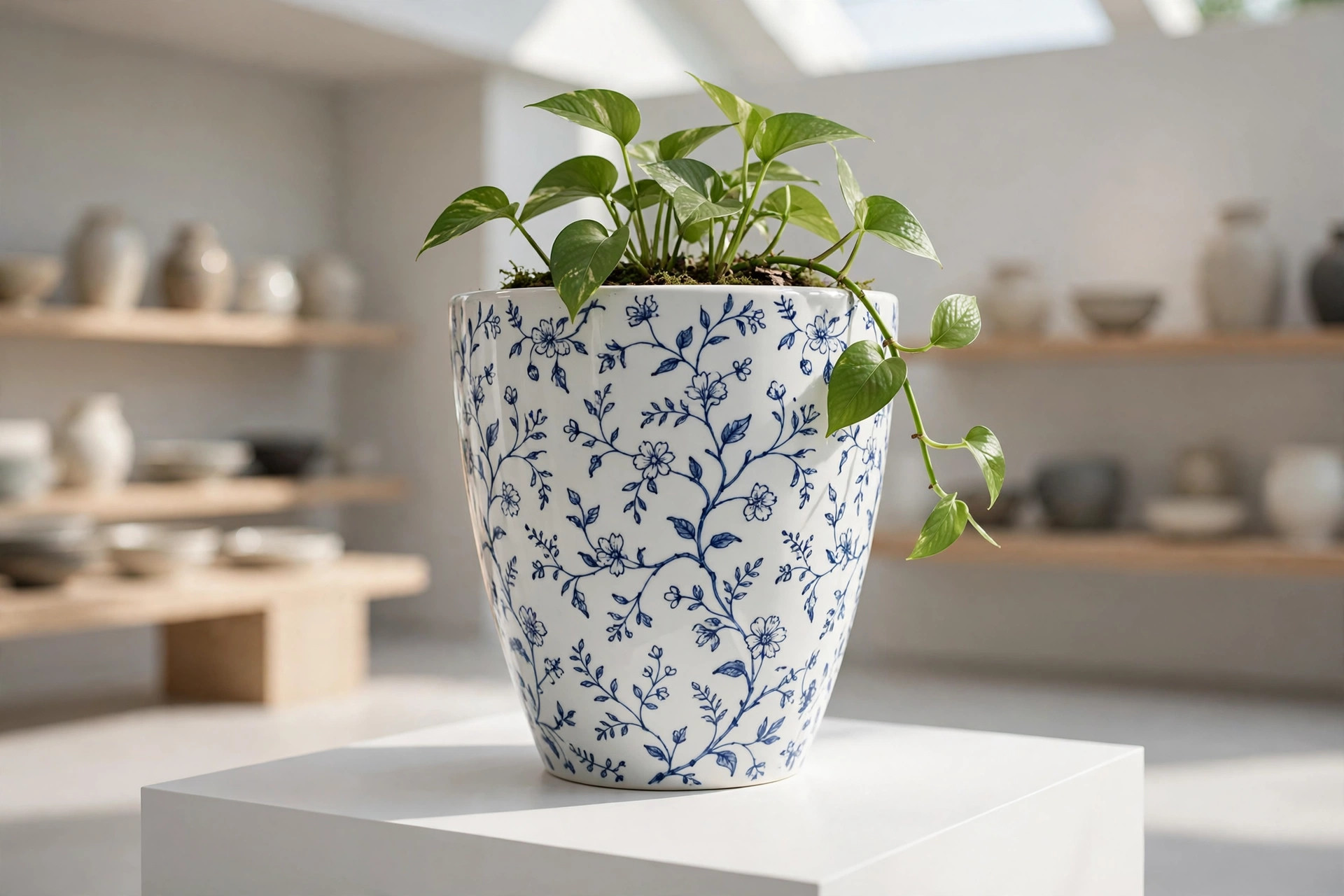
White label planters are finished planter families that a manufacturer already makes well, sold to you without their brand on them, so the pots reach your shelf under your name, your label and your packaging. That is the whole idea, and it is a good one for the right buyer. You skip the mold costs and the long development cycle of a custom line, and you still build a range your customers connect with your store, not with a factory they have never heard of. I work on the supply side of this trade, and the buyers who do well with white label are the ones who understand exactly what the term covers — and what it does not — before they sign for a container.
White label is not private label, and neither one is OEM
The common assumption is that white label, private label and OEM are three names for the same thing. They are not, and mixing them up costs money. White label means the design already exists. The shape, the sizes and the glaze are proven — they have been through sampling, production and packing before. Your choices are which families to take, in which existing finishes, with your branding applied: labels, hang tags, cartons and, where the program allows it, a stamp or decal with your name. Development time is close to zero, because there is nothing new to develop.
Private label goes one step further. The base designs may still be stock, but you choose your own glaze colors and your own retail packaging, so the range looks like yours in a way a competitor cannot copy off the same shelf. We run through that version in our guide to private label garden decor, and our process page shows where branding and packaging sit in the full sequence. OEM goes further again: your shape, made from your brief, with molds cut for you — the program we explain in our notes on OEM ceramic planters. Each step up buys you more control and costs you more time and a higher minimum.
Here is a concrete example. A garden retailer wants a blue-and-white floral family, like the one pictured here, under their own store brand for spring. As a white label order, that family already exists: three nested sizes, a proven glaze, packing that is already tested. The work is choosing sizes, approving the label and carton artwork, and setting the container mix. As an OEM order, the same look would start with drawings and molds and add months. Neither answer is wrong. They are different purchases, and you should only pay for the one you actually need.
The point is this: white label buys you speed and a proven product. It does not buy you exclusivity. The same family can sit in another retailer's range under their label. If that matters in your market, say so up front and price the private label or OEM step honestly, instead of finding out from a competitor's shelf. For the wider checklist, see our guide to choosing a planter supplier for retailers.
What to check before you commit: minimums, branding and packing
First, minimums. White label minimums are lower than custom minimums because there are no molds to pay for, but they are not small. A container program still runs per family and per finish, and the load still has to cube out. The math works the same way we explain it for custom ceramic planter MOQs — kiln runs and packing lines are set up per design, so a supplier who quotes one tiny minimum for a mixed white label order is guessing. Get the minimum per family in writing, and ask whether saucers and small decor pieces can ride in the same container. That is usually how a retailer fills a load without overbuying one design.
Second, branding — in detail, not in general. Ask exactly where your name goes. A paper label is cheap and easy to damage. A fired-on stamp or a decal under the glaze costs more and lasts the life of the pot. Hang tags, care cards and retail cartons are separate decisions with separate costs. Approve the artwork on a physical sample, not a screen file — colors shift between a monitor and a glazed surface, and the time to find that out is before production, not at your dock.
Third, packing. A white label pot is a retail product, so it has to arrive shelf-ready: no scuffed glaze, no broken rims, cartons your staff can open and price without repacking the whole load. Ask how nested sizes are separated, what sits between glazed surfaces, and how cartons are marked by family and size. Our wholesale range is planned in nested families for exactly this reason. On a retail program, packing is not a detail at the end of the order. Packing is what the customer sees first.
Compare on landed cost per sellable pot, then decide if the fit is right
Do not compare white label quotes on the price per pot at the factory door. Compare on landed cost per sellable pot: the pots, the branding, the packing, the freight, the duty and the delivery, divided by the pots you can actually put on the shelf after breakage. Freight is the part buyers underestimate. Far East to US container spot rates hit their 2026 peak in early October, at about $11,523 per 40ft container to the US East Coast, according to Xeneta, with elevated costs expected through the end of the year. At that level, a supplier who nests families tightly and protects the glaze can land your container for less, per sellable pot, than a cheaper quote with a loose load.
One honest limit. White label is the wrong tool if your whole pitch to customers is a design nobody else can sell, or if you need sizes a stock family does not come in. It is the right tool when your edge is your store, your service and your local name — and you want a proven range carrying that name this season, not next year. Plenty of strong retailers run exactly that model. The mistake is not choosing white label. The mistake is choosing it while expecting OEM control at a white label price and timeline.
Planter Happiness runs white label planters for one kind of buyer: retailers, garden centers, distributors and importers who buy by the full container. We design in Arizona and manufacture in China and Vietnam. You pick from proven families in our finishes, we apply your label and your packaging, and the container is planned so the range arrives ready to sell — trade only, no single-piece or small mixed orders. If your range grows into your own glazes or your own shapes later, the private label and OEM steps are there, and the reorder history carries over.
Tell us the families you like, the market you sell into, and the week you need pots on the shelf — we will tell you plainly whether white label fits, what the minimums look like, and what the container should carry. Start the conversation.