
Buyer's guide for retailers
Planter supplier for retailers: how to choose one that delivers
November 2026 · 6 min read
 By Janice Anastasio · Editor, Planter Happiness
A good planter supplier for retailers does more than sell you pots. They give you a range that arrives on time, in sizes that nest, in glazes that match from the first carton to the last, packed so your staff can put it straight on the bench. A bad one gives you a low price on paper and then costs you the season — late, short, or broken. I work on the supply side of this trade, and the retailers who get this right ask a different set of questions than the ones who shop on price alone. This guide is that set of questions, in the order I would ask them.
Start with the range, not the price list
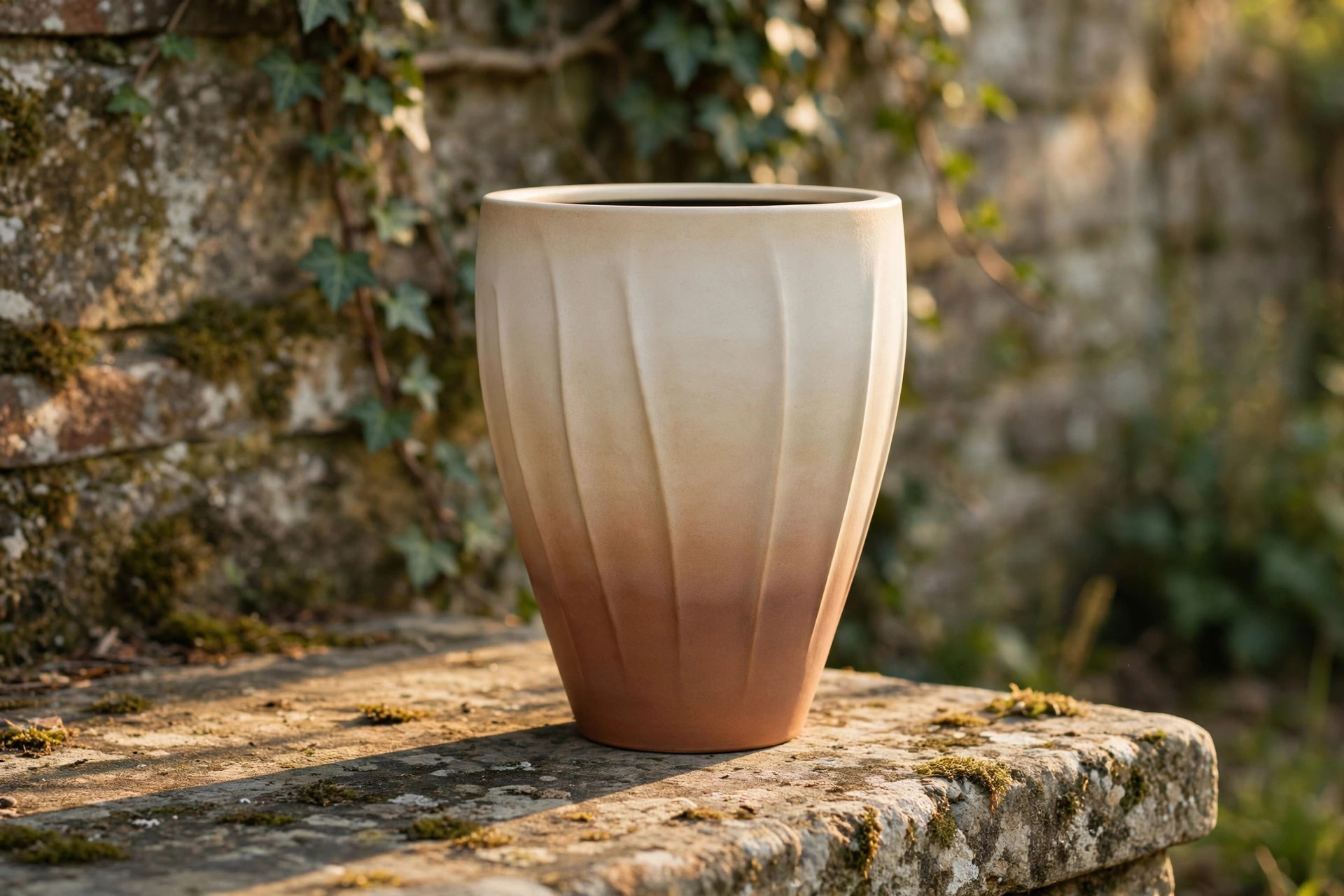
The common assumption is that a bigger catalogue means a better supplier. It does not. A retailer does not need 300 shapes. You need a small number of families that work together: two or three core shapes in nested sizes, a couple of finishes that sit well side by side, and saucers and small decor that fill the gaps in a container and on a shelf. The planter pictured here is a good test. A tall fluted shape in a cream-to-terracotta gradient only helps you if it comes in sizes that nest for freight, in a glaze the factory can repeat next season, and alongside smaller pieces your customers can carry home the same day.
Ask to see the range as families, not as single photos. Our wholesale range is planned exactly that way — nested families, with the sizes and finishes that belong together shown together. Then ask what is proven and what is new. A proven family has been fired, packed and shipped before. A new design may be beautiful and still be a gamble on cracking, glaze variation or packing. Neither is automatically wrong, but you should know which one you are buying, and the price should reflect it.
Here is a concrete example. A garden retailer building a spring range picks one strong outdoor family in three sizes, one indoor textured family in two sizes, and a decor line to fill the container. That is five decisions, not fifty, and every one of them can be checked — samples in hand, glaze approved, packing tested. A retailer who picks twenty unrelated shapes from twenty pages gets twenty chances for something to go wrong, and no single design in enough depth to reorder quickly when it sells.
The point is this: depth beats breadth for a retailer. Buy families you can reorder, not photos you liked once.
Check minimums, lead times and packing in writing
Second, get the working numbers in writing before you fall in love with a range. Minimums first. A full-container supplier will have a minimum per family and per finish, for the same reason any factory does — molds, kiln runs and packing lines are set up per design. We explain that math in our guide to custom ceramic planter MOQs, and our newer direct answer on MOQs for custom planters breaks it down by order type. If a supplier will not state a minimum per family, they have not worked out how they will make your order.
Lead times next — and lead time means to your dock, not to the factory gate. Ask for each stage: sampling if you need it, production, packing, and the sailing. Then work backwards from the week you need pots on the bench. Our process page shows the sequence we run, so you can compare any supplier's timeline against a real one. A supplier who quotes only the production weeks and leaves out the ocean leg is quoting you half a timeline.
Packing last, and do not treat it as a detail. For a retailer, packing is the product. Ask how nested sizes are separated, what sits between glazed surfaces, how cartons are marked by family and size, and what the breakage record looks like on a full container. If you are putting your own name on the range, ask the same branding questions we cover in our guide to white label planters — where the label sits, whether it survives handling, and whether you approve it on a physical sample. Pots that arrive scuffed do not sell at full price, no matter what you paid for them.
Compare on landed cost per sellable pot
Do not compare suppliers on the factory price per pot. Compare on landed cost per sellable pot: the pots, branding and packing, freight, duty and delivery, divided by the pots you can actually sell after breakage. Freight is where the comparison flips. Far East to US container spot rates hit their 2026 peak in early October, at about $11,523 per 40ft container to the US East Coast, according to Xeneta, with elevated costs expected through the end of the year. At that level, a supplier who nests tightly and packs well can land a container for less per sellable pot than a cheaper quote shipped loose.
One honest limit. A full-container supplier is the wrong fit if you need a few dozen pots next week. That is a domestic wholesaler's job, and you will pay more per pot for the speed — fairly. The container model is for retailers who can plan a season: you trade a longer lead time for a lower landed cost and a range that is yours, not the same pallet every store in town bought. If your store turns on seasonal depth rather than weekly top-ups, that trade is usually worth it. If it does not, say so early and save everyone the sampling rounds.
Planter Happiness is a planter supplier for retailers who buy by the full container — garden centers, home and garden retailers, distributors and importers. We design in Arizona and manufacture in China and Vietnam, in nested families planned for retail benches and for the container they travel in. Tell us the season you are buying for and the families you like, and we will give you the minimums, the timeline and the landed-cost picture in plain terms before you commit to anything.
Tell us what you sell, who you sell it to, and the week you need it on the shelf — we will tell you plainly whether a container program fits and what it should carry. Start the conversation.