
Garden center buying notes
Frost-proof ceramic planters for garden centers
November 17, 2026 · 6 min read
 By Janice Anastasio · Editor, Planter Happiness
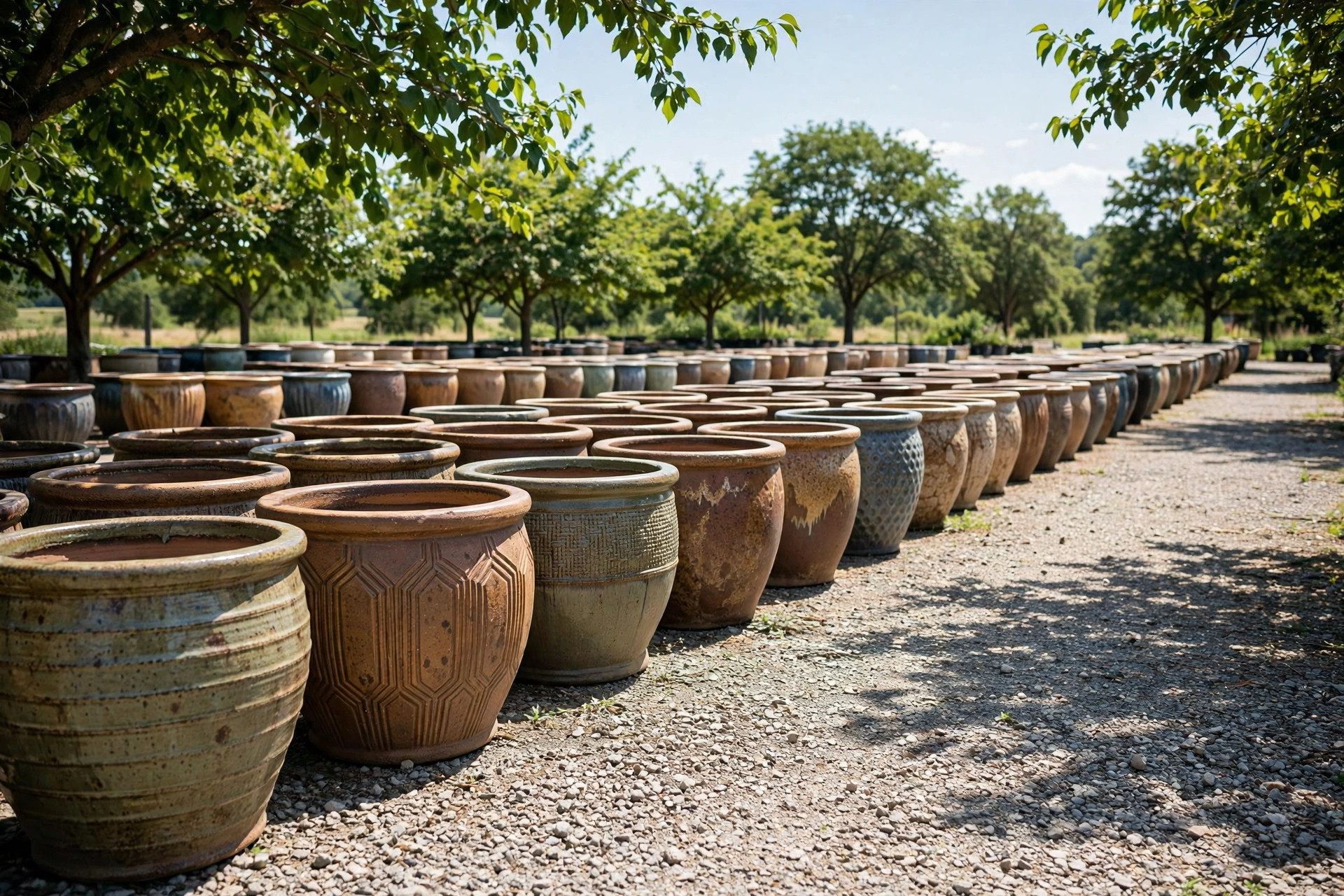
Frost-proof ceramic planters for garden centers are not a style category — they are a performance promise. A frost-proof planter is a high-fired, low-absorption ceramic pot that can stay outdoors, planted, through repeated freeze–thaw cycles without cracking, spalling or shedding its glaze. For a garden center, that promise is the difference between a durable outdoor range customers trust and a spring returns queue of split pots. This guide explains what actually makes a planter frost-proof, how to write it into an order specification, and how to sell and store the range so the promise holds in real gardens, not just on the label.
I write this from the manufacturer's side, and the first thing to say plainly is that no ceramic is frost-proof in every situation. A pot that sits waterlogged, with its drainage hole blocked, through a hard freeze can fail whatever it is made of — water expands about nine percent as it turns to ice, and trapped water will find the weakest point. What a good frost-proof spec does is stack the odds: a body that absorbs very little water, walls thick enough to take the pressure, drainage that actually drains — specified properly in our drainage holes and saucers specification for wholesale buyers — and honest care guidance on the ticket. Garden centers already buying our wholesale ceramic pots for garden centers range will recognise the pattern — the outdoor lines in our products range are separated from indoor lines for exactly this reason.
What makes a planter frost-proof: absorption, firing and walls
The number that matters most is water absorption — how much water the fired clay body soaks up, measured as a percentage of its dry weight. Ordinary low-fired earthenware can absorb ten percent or more, which is why terracotta left wet outdoors flakes and cracks after a cold winter: the water inside the wall freezes, expands, and pushes the surface off. Stoneware fired at high temperature vitrifies — the body partly turns to glass — and absorption drops to around three percent or less. At that level there is simply very little water inside the wall to freeze, so the freeze–thaw cycle loses its leverage. When you spec an outdoor range, ask for the absorption figure in writing, not the words "frost resistant" on a catalogue page. The two phrases are not the same: frost-resistant usually means the pot tolerates light frost; frost-proof should mean low absorption, high firing, and testing behind it.
Wall thickness and shape do the rest of the work. Thin, sharp-angled walls concentrate stress; generous, even walls with rounded transitions spread it. Glaze matters too — a fully glazed exterior sheds water instead of drinking it, but the base and drainage hole are always unglazed or thinly glazed, which is why a frost-proof pot should stand on feet or a slight plinth rather than flat in a puddle. None of this is visible in a showroom photograph, which is why it belongs in the specification alongside dimensions and glaze names — the same discipline we describe in ceramic planter quality control and pre-shipment inspection: if a performance detail is not written down and checked, it is a hope, not a standard.
How to spec and test a frost-proof range before you order
Write four things into the order. One, the body: high-fired stoneware with a stated maximum water absorption, agreed per design. Two, the construction: minimum wall thickness for the large sizes, a drainage hole sized and positioned to actually clear water, and pot feet or a raised base on the biggest pieces. Three, the test: before a full container is committed, run a simple freeze–thaw check on production samples — soak the pots, freeze them hard, thaw, and repeat for several cycles, then inspect for hairline cracks, glaze lifting and spalling, especially at the rim and base. It is a crude test and a very effective one; a body that is going to fail usually announces itself within a few cycles. Four, the labelling: the ticket should say what the pot is rated for and how to keep it that way — plant with free-draining compost, keep the hole clear, raise the pot off standing water, and empty and shelter purely decorative pieces in the coldest zones.
Timing matters as much as testing. Outdoor ranges are spring sellers, but the container has to be ordered, made, fired, tested and shipped months earlier — which is why frost-proof buying belongs in the autumn conversation, not the January panic. The worked-backwards dates are set out in our ceramic planter lead times and ordering calendar for spring. Our process page sets out the development and production sequence; build the freeze–thaw check into the sample stage, while a body or glaze change is still cheap, rather than discovering a problem in a pre-shipment inspection when the only options left are expensive ones. And protect the investment in transit the same way you protect any container of ceramics — the packing principles in how to reduce breakage when importing ceramic planters apply in full to heavy outdoor pieces, which punish weak cartons more than small indoor pots do.
Selling and storing frost-proof pots so the promise holds
On the bench, sell the performance honestly and specifically. Group the frost-proof range together, sign it with the absorption and firing story in plain language, and train the answer to the customer's real question — "can I leave it out all winter?" — which is: yes, planted and draining freely; no pot of any material should sit in standing water through a freeze. That honesty sells. A customer who is told the one condition, and follows it, comes back for the matching pair; a customer who was oversold a light-frost pot as fully frost-proof comes back with the pieces. Returns on outdoor ceramics are rarely about the weather — they are about a mismatch between the promise on the ticket and the body in the kiln.
Storage deserves the same care. Keep unsold stock off bare wet ground, nested only with the packing it arrived in. If your yard overwinters display pieces, empty them and tip them to drain — trapped moisture, again, is the enemy, not cold air itself. Done this way, a frost-proof range becomes one of the most reliable categories on the yard: heavy, durable, weather-honest stock that does not come back.
So the short version: buy the body, not the label — high-fired, low-absorption stoneware, specified in numbers; walls and drainage designed for standing water to escape; a freeze–thaw test passed at sample stage; and tickets and bench advice that tell the customer the one condition that keeps the promise. Garden centers that spec it that way can sell outdoor planters with a straight face in any climate zone they serve.
Tell us your climate zone, the sizes your outdoor bench turns fastest, and your spring shelf date — we will propose a frost-proof range with the absorption figures, test results and container plan behind it. Start the conversation.