
Buyer's guide for garden centers
Wholesale ceramic pots for garden centers
October 2026 · 6 min read
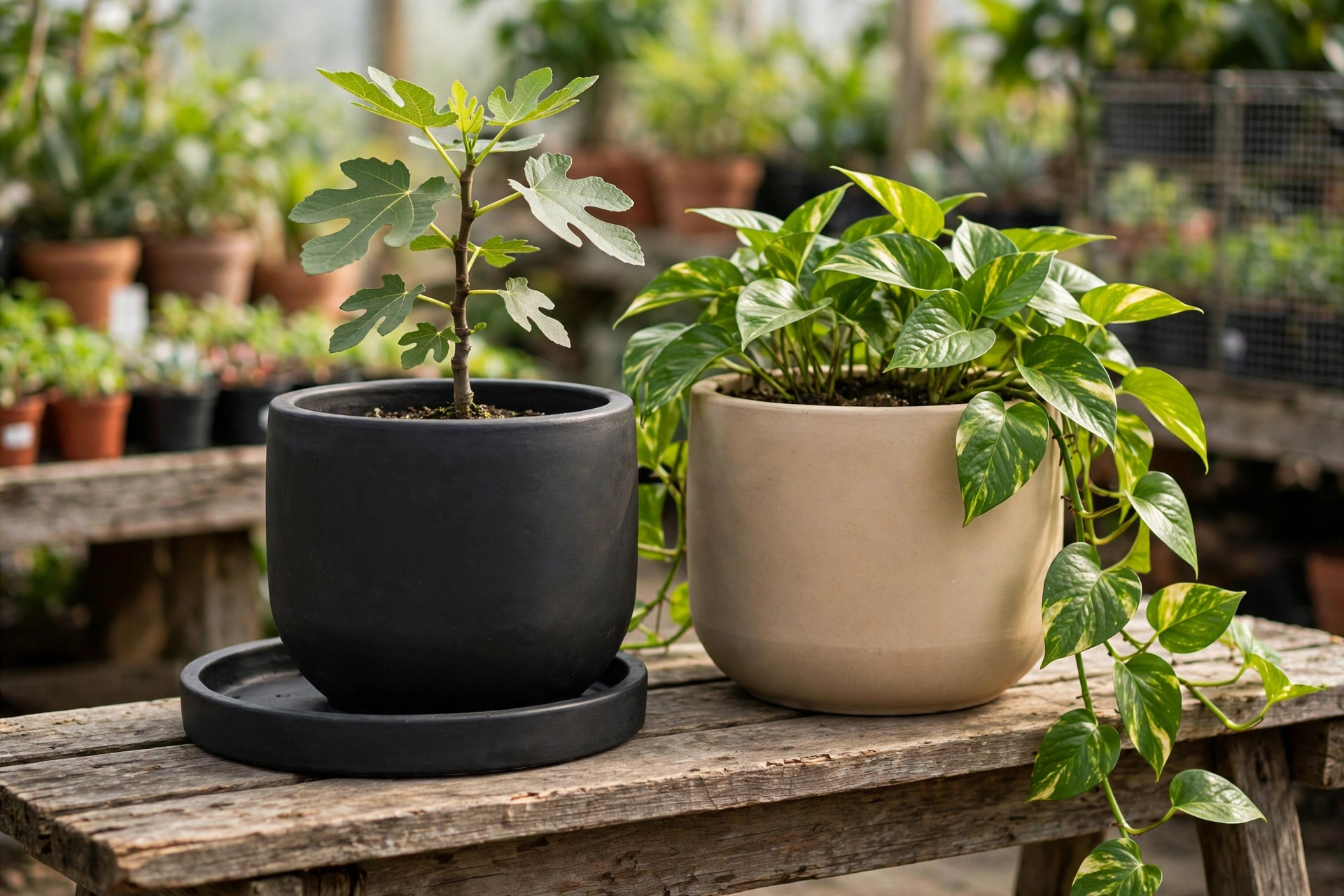
Choosing wholesale ceramic pots for garden centers is not the same as choosing pots for a big-box program or an online catalog. A garden center sells in person, in season, to a customer who can pick the pot up, turn it over, and picture it on their patio. That changes what matters: weight in the hand, finish in daylight, sizes that match the plants you actually stock, and price points that let staff build a planted combination without a hard sell. This guide covers how experienced garden center buyers build a ceramic assortment that sells through — sizes, glazes, quantities, and the container math behind it.
Start with the plants and benches you already have
The most common assortment mistake is buying pots as decoration first and plant containers second. Work backwards from your plant tables. List the pot sizes you sell the most plants in — typically 4-inch, 6-inch, 8-inch, 10-inch and 12-inch equivalents — and make sure every ceramic family you buy covers the heart of that range, with drainage and saucers that actually fit. A beautiful 14-inch statement pot with no matching 6-inch companion leaves money on the table: customers buy in sets, and staff plant in sets.
Think in families, not single SKUs. A family is one shape and glaze in three to five nested sizes, plus a saucer. It merchandises as a wall or an endcap, it lets a customer trade up a size without leaving the display, and it reorders cleanly. Three strong families with depth will usually outsell eight shallow ones. Our wholesale range is built this way — ceramic, decor, wood and durable lines developed as coordinated families — because garden center buyers told us that is how their benches work.
Allow one or two hero pieces per family: a larger, higher-priced pot that anchors the display and makes the mid-sizes look like good value. Heroes do not need to be your volume sellers. They need to stop foot traffic and frame the rest.
Glazes and finishes that sell in daylight
Garden centers sell under natural light, and that is unforgiving. Matte and satin finishes hide water spots and handling marks better through a long season on the bench. Reactive and crackle glazes photograph well and justify a premium, but judge them on physical samples outdoors, not on a screen — the same rule we give custom buyers in our guide to how to develop custom planters with a manufacturer. What looks rich on a monitor can look muddy in sun, and the reverse is also true.
Color planning matters as much as finish. Anchor the assortment in neutrals that work with any plant — warm white, sand, charcoal, terracotta tones — then add one seasonal color story in limited depth. Neutrals carry your reorder; the color story creates the reason to visit this spring rather than next. If you want that color story under your own label, a private label garden decor program lets you run proven shapes in your own glazes and packaging, so the assortment looks like yours, not like every other center that bought the same open line.
Ask about frost resistance honestly, by market. A pot sold for a covered patio in Arizona and a pot left out through a Midwest winter are different products. Get the manufacturer's rating in writing, label accordingly in store, and you will avoid the returns conversation that damages trust more than any price point.
Quantities, MOQs and the container math
Most independent and regional garden centers do not fill a 40ft container with one pot — and they should not try. The practical model is a mixed container: several families, nested sizes, saucers and a decor companion or two, planned together so the load cubes out efficiently. Nesting is money. Pots that nest well can double the units per container versus pots that ship air, and that difference flows straight into landed cost per pot.
Minimums work the same way. As we explain in our breakdown of custom ceramic planter MOQs, MOQ is driven by mold, kiln and packing economics, not by a supplier being difficult. Stock families carry far lower minimums than fully custom shapes, which is why many centers mix both: stock and private label families for the core bench, plus one exclusive OEM ceramic planter family that competitors cannot copy. That exclusive family takes longer — plan on the timelines in our guide to how long it takes to develop a custom planter — while the stock families cover the coming season.
Freight deserves a line in every buying decision this year. Far East–US container spot rates hit their 2026 peak in early October, at about $11,523 per 40ft container to the US East Coast, per Xeneta, with elevated costs expected through year-end. When freight is that large a share of landed cost, a slightly higher FOB price for a better-nesting, lower-breakage pot is often the cheaper pot on your bench. Compare suppliers on landed cost per sellable pot — after breakage — never on FOB alone. Our process page shows how we build packing and inspection around that number, including pre-shipment checks while goods are still at the factory.
Sell-through: pricing, planting and reordering
Price in clear steps. A customer should be able to see why the next size up costs what it does, and staff should be able to quote the planted combination — plant plus pot plus saucer — without a calculator. Keep the opening price point genuinely buyable; it is the pot a hesitant customer starts with, and it feeds the set.
Plant your best sellers. A ceramic pot with the right plant in it sells both items, shows scale honestly, and survives handling questions before they are asked. Rotate planted displays to the families you have depth in, not the ones down to three units.
Finally, plan the reorder when you place the first order. Reorders of proven families are much faster than first orders — molds exist, glazes are approved, artwork is on file — typically production plus transit. Note your sell-through by size weekly in the first month; the size that empties first is rarely the size buyers guessed. Centers that share that data with their supplier get a second container that is weighted correctly, instead of a repeat of the first container's mistakes.
The bottom line
Wholesale ceramic pots for garden centers work when the assortment is built from your plant sizes outward: families with depth, glazes judged in daylight, mixed-container quantities that nest well, and pricing that lets staff sell the planted combination. Do that, and ceramic stops being a risky hard-goods bet and becomes one of the most reliable margin lines on the bench.
Tell us how many locations you buy for, the plant sizes that drive your bench, and your target shelf date — we will propose a family mix and container plan sized for a garden center, not a warehouse club. Start the conversation.