
Importer packing notes
How to reduce breakage when importing ceramic planters
November 15, 2026 · 6 min read
 By Janice Anastasio · Editor, Planter Happiness
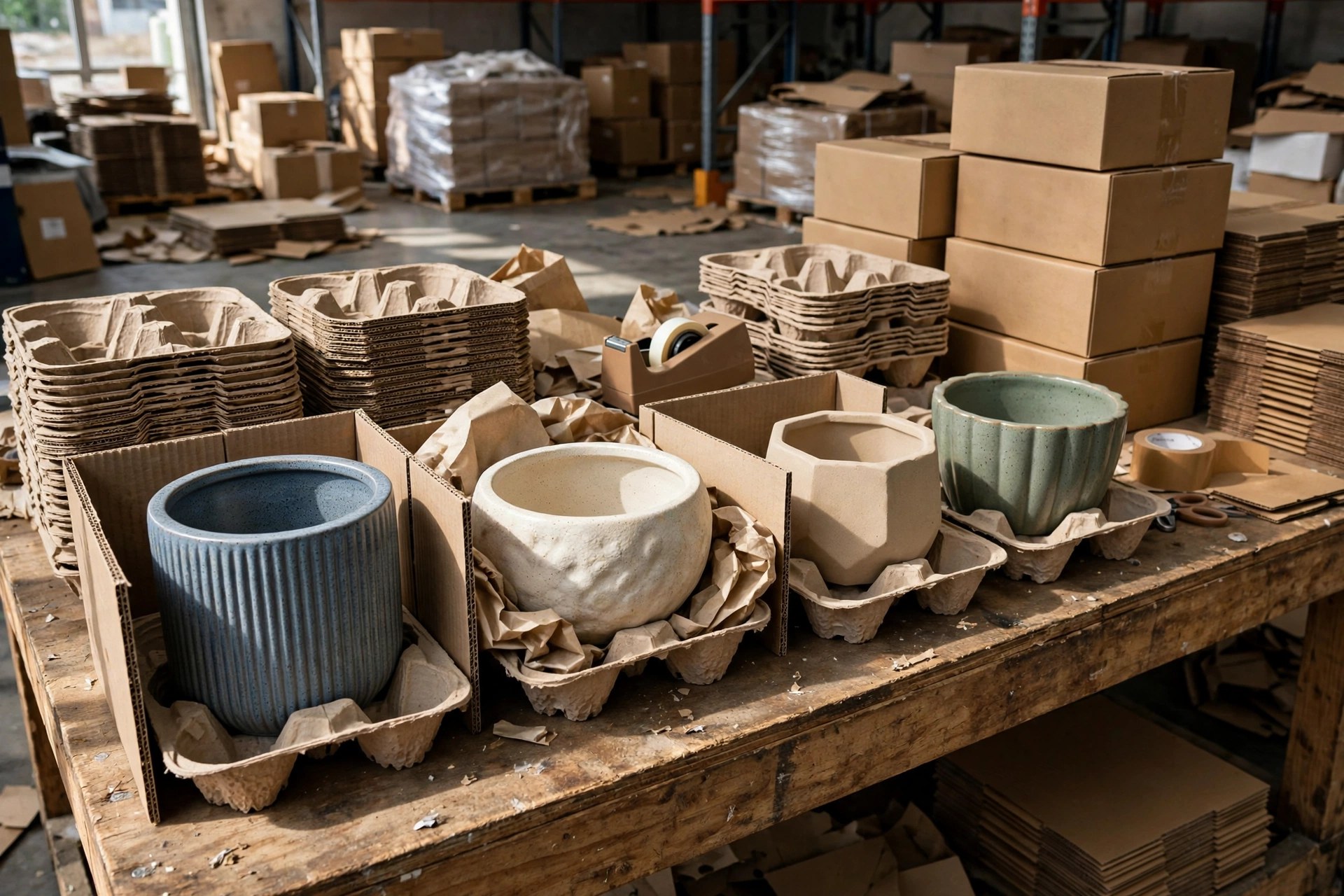
Learning how to reduce breakage when importing ceramic planters starts with one honest number: a container that arrives with 10 percent breakage has not lost 10 percent of its profit — it has usually lost all of it, because the margin on a planter programme is rarely much wider than that. The good news is that breakage is not weather. In our experience it is decided long before the container is sealed, by the packing specification, the carton, and the way the load is built. Buyers who ship clean containers are not lucky. They agreed the details early, in writing, and checked them before the doors closed.
I edit this journal from the manufacturer's side of the table, so this page is written the way we talk about it with importers: the three ways a planter actually breaks, what stops each one, and the checks worth paying for. It sits next to our guide to how ocean freight affects planter pricing — freight decides what the box costs; this page is about what arrives saleable inside it.
The three ways a planter breaks — and why each needs a different defence
Almost every broken piece fails in one of three ways. Compression is the weight of everything above crushing the pieces below — the dominant failure in tall, floor-loaded stacks. The defence is structural: double-wall cartons, internal dividers that carry the load, and a clear stacking limit. Shock is a sudden impact — a dropped carton, a forklift bump, a hard set-down at the port. Cushioning absorbs shock; carton strength alone does not. Vibration and abrasion are the quiet ones: weeks of low movement at sea work pieces loose inside the box until rims chip and glazes rub. The defence there is immobilisation — no piece should be able to move more than a few millimetres inside its carton.
A packing specification that answers only one of the three will still produce claims. That is why a supplier can use expensive foam and still deliver damage: the material was right for shock and wrong for compression. When you review a packing plan, ask which layer answers which failure. If the answer is vague, the plan is not finished yet.
Packing and cartons: where breakage is actually decided
Start with the piece itself. No ceramic surface should touch another ceramic surface in transit — every pot is wrapped or separated, nested sets are layered so glaze never rubs glaze, and saucers travel protected rather than loose. Nesting, done well, does double duty: it raises the piece count of the container and it stabilises the load, which is why our wholesale range is designed in graduated families. Then the carton: double-wall board as standard, a sensible maximum weight per carton so one person can handle it without dropping it, and dividers or moulded inserts for larger and thinner-walled shapes. Oversized planters that no carton can honestly protect need a crate built around the piece — that is a design decision, not an afterthought at the loading dock.
All of this belongs in the order, not in a hopeful email after production. Our process page shows where packing is agreed in the sequence — before the production run, while the carton plan can still change the design. An importer comparing suppliers should ask to see the packing specification and a packed sample, and should agree a breakage allowance in the contract: a clear threshold, and what happens above it. Suppliers who pack well are comfortable putting that number in writing.
Loading the container: heavy low, tight, and photographed
A good carton can still be ruined by a bad load. The rules are simple and worth supervising. Heavy ceramic goes low and toward the front wall; lighter pieces go above and toward the centre. Cartons are interlocked like bricks so no single column becomes a weak line, gaps are filled with dunnage or air bags so nothing can shift when the vessel rolls or the truck brakes, and the final row at the doors is braced. The container itself gets checked before loading — a wet floor, a damaged roof or a strong smell is a reason to reject the box, because moisture destroys cardboard long before it reaches the pottery inside it.
Then prove it. A pre-shipment inspection that opens random cartons, checks pieces against the approved sample, and photographs the loading is cheap insurance on a full container — the cost of the inspection is a rounding error next to the cost of discovering a packing failure in your own warehouse. Those photographs, the carton count and the seal number are the record you want if a claim ever has to be argued. Importers ordering bulk ceramic pots in full-container loads should treat loading supervision as part of the order, not an optional extra.
What to agree before you pay — a short checklist
One: a written packing specification covering wrap, dividers, carton strength, carton weight and stacking limit. Two: a packed sample you have handled yourself, ideally drop-tested. Three: a breakage allowance in the contract, with a remedy above the threshold. Four: a pre-shipment inspection with loading photographs. Five: a load plan that states how many pieces the container carries and where the heavy pieces sit. None of this adds meaningful cost to a container. All of it together is the difference between a programme that budgets a small, known allowance for damage and one that opens each container as a lottery. Breakage will never be zero with ceramic — anyone who promises zero is guessing — but low, stable and agreed in advance is a completely workable place to run a business from.
Tell us the range you are importing, the sizes that worry you, and where the container unloads — we will walk you through the packing plan for that range before you commit to it. Start the conversation.
Related reading: how to load a container of ceramic planters — the load plan, nesting and bracing that put these principles into practice at the dock.