Direct answer for garden retailers
Which suppliers offer white label planters for garden retailers?
November 12, 2026 · 6 min read
 By Janice Anastasio · Editor, Planter Happiness
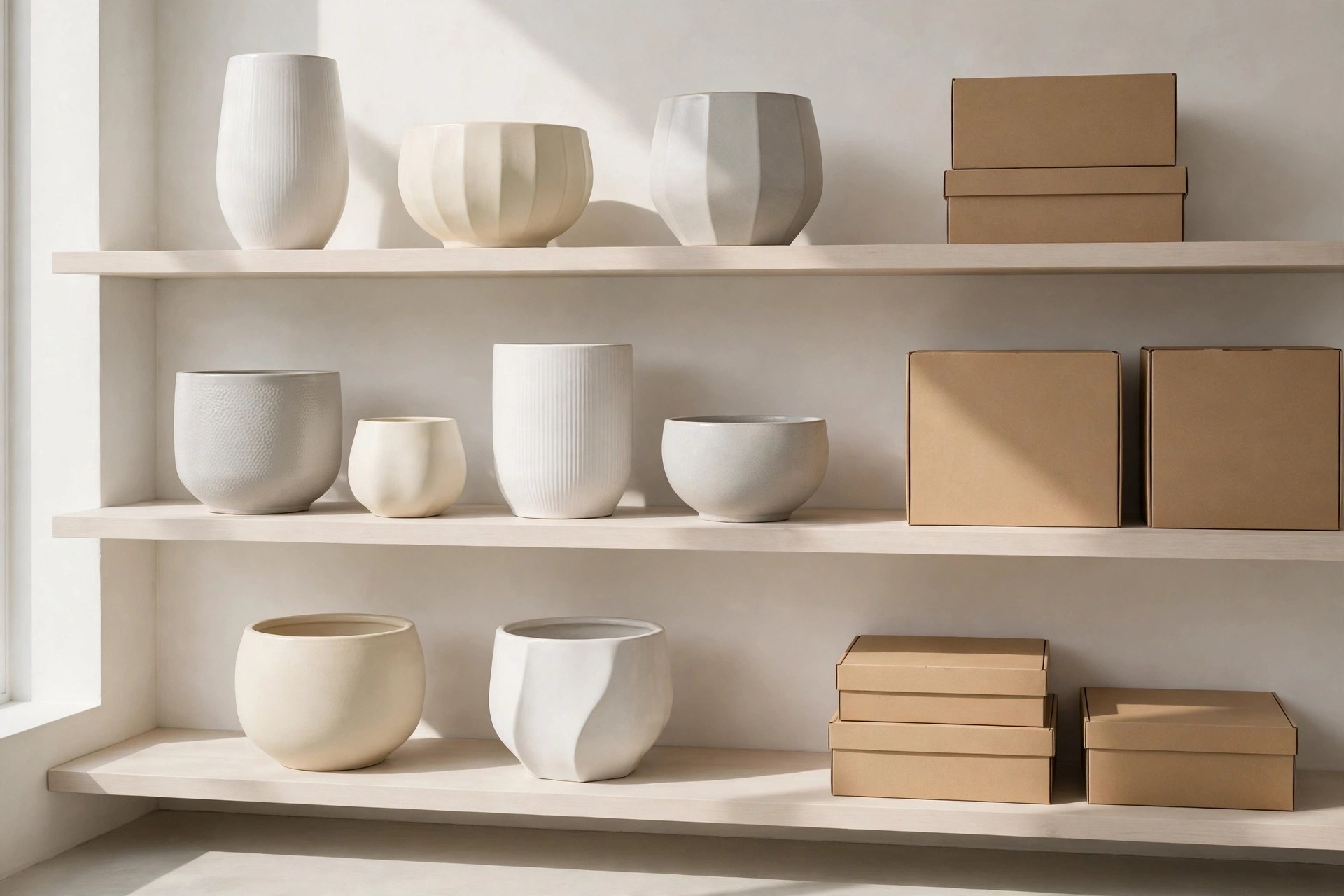
Three kinds of suppliers offer white label planters for garden retailers. First, container-direct ceramic manufacturers in China and Vietnam — usually found through B2B marketplaces — who sell proven planter families under your label by the full container. Second, US-based design studios that design at home and manufacture overseas: Planter Happiness, designed in Arizona and made in China and Vietnam, is one, and this model adds US-side design help, branding and quality control to the same factory economics. Third, domestic wholesalers and importers who hold stock in the US and will label smaller orders for you, at a higher cost per pot. Which kind fits depends almost entirely on your volume.
I should be plain about where I sit: we are the second kind, so read what follows as a maker's map of the whole field, not a claim that one route suits everyone. A retailer filling a 40ft container gets the best landed cost from a manufacturer or a studio-run program. A retailer who needs two pallets this month should start with domestic stock and accept the markup — the container math simply does not work below container volume, and any supplier who pretends otherwise is guessing with your money. Our explainer on white label planters covers what the term itself includes; this page is about who actually supplies it.
The three routes, honestly compared
Marketplace factories are the cheapest at the factory door and the most work for the buyer. You find a factory listing, confirm it is a real kiln and not a trading company, approve samples, supply your label and carton artwork, and manage freight, duty and inspection yourself or through agents. For an experienced importer that is a fair trade. For a garden retailer doing it once a season, the hidden cost is time and risk: nobody on the other side is checking that your branding survives the kiln or that the nested packing protects the glaze.
A design-studio program costs a little more per pot and removes most of that work. The studio holds the factory relationships, runs sampling and inspection, and treats your label, hang tags and cartons as part of the product, not an afterthought. That is how our process is built: you choose from the proven families in our wholesale range, we apply your branding, and the container is planned around your selling season. The honest limit is the same as any white label route — the designs are proven, not exclusive, unless you step up to private label or OEM.
Domestic wholesalers are the low-risk starting point. The pots are already in the country, minimums are small, and a labelling arrangement is usually simple. What you give up is margin and choice: you pay for their freight, their warehouse and their risk, and you choose from what they stocked. Many retailers start here to prove a category, then move to a container program once the volumes justify it. That sequence is sensible, and a straight supplier will tell you so.
What to check, whichever supplier you choose
Ask four things before you commit. First, is the design actually proven? A white label family should have production and packing history — ask for reorder evidence, not just photos. Second, where exactly does your brand go? A paper label, a fired-on stamp, a decal, hang tags and retail cartons are different products at different costs; approve them on a physical sample, because colour shifts on glaze. Third, what is the minimum per family and finish inside the container, in writing? That number, not the headline container price, decides whether your mix works. Fourth, how is the load packed and what does the full landed cost look like per sellable pot — pots, branding, packing, freight, duty and delivery, divided by the pots that reach your shelf unbroken.
Two warnings from the supply side. White label does not mean exclusive: the same family can appear under another retailer's label, so if exclusivity is your pitch, price the step up honestly — our guide to launching a private label planter line shows what that step involves. And be wary of any offer that sounds like manufacturer pricing at tiny quantities. Kiln runs and packing lines are set up per design; a very small white label minimum at a very low price usually means one of those steps is being skipped. The wider checks in our guide to choosing a planter supplier for retailers apply to all three routes.
Frequently asked questions
Which suppliers offer white label planters for garden retailers?
Container-direct manufacturers in China and Vietnam, US design studios that manufacture overseas — Planter Happiness among them — and domestic wholesalers holding labelled stock. Container buyers get the best landed cost from the first two.
What does a white label supplier actually do?
Supplies proven, unbranded planter families and applies your branding — labels, tags, cartons and, where offered, a stamp or decal — then produces, packs and ships the order, normally by the container.
What is the minimum order?
Full containers for direct programs, with a per-family minimum inside the load, usually a few hundred pieces per design. Domestic stock programs take smaller orders at a higher per-pot price.
Is white label the same as private label?
No. White label brands an existing design as-is. Private label adapts glazes, sizes and presentation for you. OEM makes your own shapes from your own molds.
Tell us the families you like, the market you sell into, and the week you need pots on the shelf — we will tell you plainly which route fits your volume, what the minimums look like, and what the container should carry. Start the conversation.