Direct answer for importers
Is it better to source ceramic planters from Vietnam or from China?
November 8, 2026 · 6 min read
 By Janice Anastasio · Editor, Planter Happiness
For most US importers buying full containers today, Vietnam is the better default for hand-finished, textured and reactive-glaze planters in mid-range volumes, because Vietnamese ceramics do not carry the additional Section 301 duty that applies to most Chinese ceramics entering the United States. China remains the better choice for very large volumes, exact uniformity across huge runs, and the lowest factory price on standardised lines. Neither country is better for everything — and any supplier who tells you one origin always wins is selling you a factory, not an answer.
Planter Happiness designs in Arizona and manufactures in both countries, so we place each family where it will be made best and land cheapest. The decision runs on three questions, in this order: where do you sell, what do the pots look like, and how many do you buy? Work through them honestly and the origin usually chooses itself. Our longer Vietnam vs. China sourcing comparison covers the same ground factor by factor; this page is the short version buyers can act on.
Start with where you sell: the duty line beats the factory price
The most common mistake is comparing factory prices and calling the cheaper one the winner. The point is, the factory price is only the first line of your cost. For US importers, Section 301 adds 25 percent on top of normal duty for most Chinese ceramics — a surcharge Vietnam does not carry. So a Chinese planter that leaves the factory 10 percent cheaper can easily land 15 percent more expensive than the same pot made in Vietnam, once duty is applied to the full declared value. If you sell into the United States, that one line outweighs most factory-price gaps, and it is why so much planter sourcing has moved to Vietnam in the last few years.
If you sell into Europe, the UK or Australia, the duty gap is smaller and this question carries less weight — the decision then turns mostly on the pots themselves and your volume, below. Either way, compare the two origins the way we set out in our guide to the total landed cost of importing a container of ceramic planters: total cost to your warehouse, divided by the pots you can actually sell. On that basis Vietnam wins more US comparisons than the factory quotes suggest, and China wins the ones where scale, not duty, is doing the work.
Then match the country to the pots
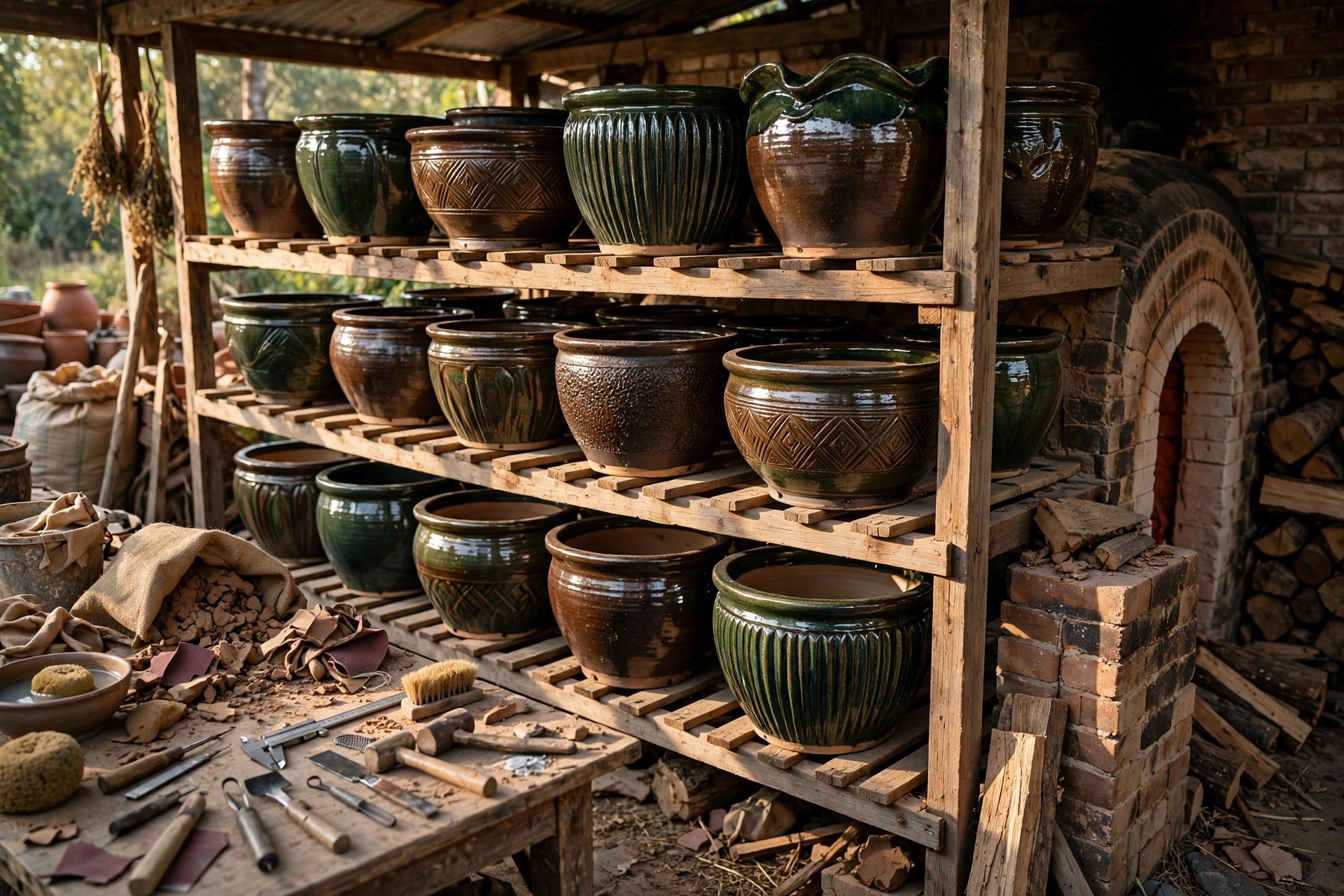
Vietnam's strength is character. Pottery villages such as Bat Trang have worked clay for centuries, and Vietnamese kilns are genuinely better at the hand-finished looks that sell in Western garden retail right now — reactive and drip glazes, carved and ribbed textures, and the small, natural variation from pot to pot that reads as handmade rather than flawed. If your range in the wholesale catalogue leans organic and textured, Vietnam will usually make it better, not just cheaper to land.
China's strength is precision. Its supplier base is deeper, its tooling faster, and its best factories hold an exact colour and finish across tens of thousands of units in a way Vietnam's smaller sector cannot yet match at the same price. If your program needs crisp, uniform, glossy lines — the same pot, identical, in every store — China is the safer origin. Neither strength is a quality judgement: both countries have excellent exporters and both have workshops that will ruin a season. What decides quality is the vetting, sampling and inspection behind the order, which is why our process puts design, communication and quality control under one accountable roof whichever country's kilns fire the pots. Our step-by-step guide to sourcing ceramic planters from Vietnam shows what that vetting looks like in practice.
Finally, match the country to your volume — and consider using both
China still holds the capacity advantage. For very large programs — dozens of containers a season, or a tight deadline that needs tooling and production turned around fast — its scale is hard to beat. Vietnam's export ceramics sector is smaller and growing, and peak-season capacity tightens: book Vietnamese production early for spring programs, and do not assume a kiln that had room in October will have room in January.
For a broad assortment, the honest answer is often both. Importers we work with commonly split the program: hero, hand-finished families from Vietnam, where the look and the US duty both favour it, and high-volume uniform lines from China, where scale and unit cost favour it — each origin filling its own containers, under one design and quality process. Splitting also spreads risk: a delay, a capacity crunch or a policy change in one country no longer stops your whole season. The point is to treat origin as a product decision, family by family, not a loyalty decision you make once and defend for years.
Tell us where you sell, the families you are building and the volumes you have in mind, and we will tell you plainly which origin — or which split — fits each part of the range, with the landed-cost picture to show for it.
Frequently asked questions
Is it better to source ceramic planters from Vietnam or from China?
For most US importers, Vietnam is the better default for hand-finished ranges at mid-range volumes, because it avoids the extra Section 301 duty on most Chinese ceramics. China is better for very large volumes and exact uniformity. Decide on where you sell, what the pots look like, and how many you buy — in that order.
Is Vietnam cheaper than China?
At the factory gate, China is usually cheaper on standardised lines and Vietnam is often within about 5 to 15 percent. Landed in the US, Vietnam frequently wins once the 25 percent Section 301 addition on most Chinese ceramics is counted. Compare landed cost per sellable pot, never the factory price alone.
Can I source from both countries?
Yes. A common split puts hand-finished and reactive-glaze families in Vietnam and high-volume uniform lines in China, each filling its own containers. Run under one partner, the split adds no extra supplier relationship to manage.
Tell us what you import, who you sell it to, and when you need it — we will give you a straight read on the right origin for each family. Start the conversation.