
Direct answer for garden center buyers
What planter styles, colours and glazes will garden centers sell best in 2027?
November 14, 2026 · 6 min read
 By Janice Anastasio · Editor, Planter Happiness
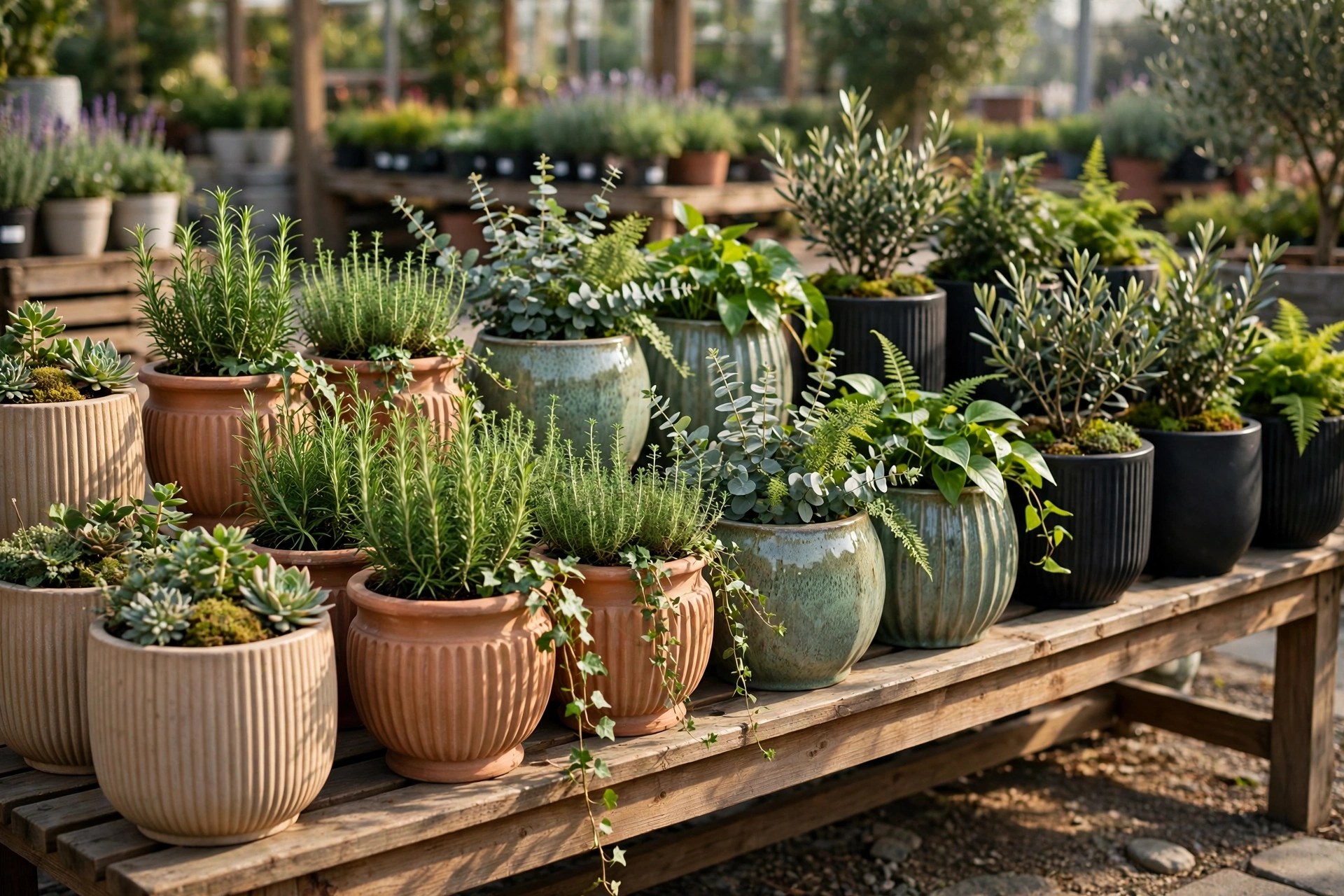
For 2027, garden centers will sell best with five things: warm matte neutrals — sand, clay, warm grey and matte black — as the volume base; reactive glazes in sage, celadon and deep botanical green, where no two pieces come out of the kiln identical; textured surfaces — ribbed, fluted and hand-finished — that read as premium at mid-tier prices; classic terracotta and cream, which never leave the top sellers; and a small number of large statement sizes, 50 cm and up, that lift the perceived value of everything merchandised around them. The assortment that wins is not the one with the most styles — it is the one that buys these as coordinated families in a planned size ladder.
I edit this journal from the manufacturer's side of the table, and this answer is built from the development briefs garden centers and distributors actually sent us through 2026 — what they asked to sample, what they reordered, and what they quietly dropped. Our earlier overview of pottery trends for 2027 covered the five broad movements; this page is the buying version: which colours, glazes and shapes to put real container volume behind, and in what proportions.
The colours and glazes to buy in depth
Warmth is the story. The cold greys and stark glossy whites of the last decade are fading from briefs, replaced by sand, clay and warm stone tones that sit comfortably next to both terracotta and foliage. Matte black has become the anchor neutral — it makes green plants look greener, pairs with everything, and photographs cleanly for the online listings your customers browse before they visit. If you stock one dark colourway in depth for 2027, make it a true matte black with a matching saucer; sets outsell singles.
The growth layer is reactive glaze. Sage, celadon crackle and deep green drip glazes vary across every piece, and that variation — once treated as a quality problem — is now what customers pick up and turn over in their hands. Merchandise reactives in tonal groups of six to twelve pieces rather than as single colourways: the spread of tones is the display. One caution from the factory side: reactive glazes must be approved on physical production samples, not catalogue photos, because the range of variation is the product. A supplier who will not state an acceptable variation range in writing is telling you something.
The styles and shapes that carry the season
Texture is doing the premium work in 2027. Ribbed and fluted profiles, soft hand-carved surfaces and subtle hammered finishes catch light across an aisle and hold up in a phone photo — buyers now ask for both by name. The useful part for your margin: texture costs little to produce, so a ribbed pot can sit at a mid-tier price while looking a shelf above its neighbours. Smooth, plain cylinders still sell, but increasingly as the neutral base of a range rather than the feature.
Shape-wise, keep the ladder simple and complete: core 6- to 12-inch rounds and squares for the volume, tapered and pedestal forms for the trend layer, and a deliberate handful of oversized statement pieces. One hero pot per display is enough — its job is to raise the value of the standard sizes around it, not to sell in quantity, and its freight cost should be judged that way. Our guide to wholesale ceramic pots for garden centers works through the bench-by-bench side of building this range, and our wholesale range shows the families we build these ladders from.
How to split the buy — and when to place it
The split that keeps proving itself is roughly 60 to 70 percent of units in core sellers — matte neutrals and terracotta in the sizes your customers reorder — 20 to 25 percent in the trend layer of reactive glazes and textures, and 10 to 15 percent in statement sizes. Buy each colourway as a family across the size ladder, so a customer who buys the 8-inch sage pot in March can add the 12-inch in May. Families are also how a container fills efficiently: a garden pottery wholesale supplier who plans the load family by family will quote you better nesting, fewer breakages and a cleaner landed cost than one quoting a mixed pick list.
Timing matters more than most buyers expect. Custom development runs months from sketch to production — our process page lays out the stages honestly — and even stock families need production, packing and ocean freight before they reach your warehouse. Centers that confirm their spring 2027 programs in autumn keep the full choice of styles and glazes; centers that order in January choose from whatever is already made. If a 2027 family is still a sketch in your notebook, the development window is open now, but it is not open for long.
Frequently asked questions
What planter styles, colours and glazes will garden centers sell best in 2027?
Warm matte neutrals as the base, reactive glazes in sage, celadon and deep green as the growth layer, textured ribbed and fluted surfaces for premium feel, classic terracotta and cream, and a few large statement sizes — bought as coordinated families, not one-offs.
Which planter colours are trending for 2027?
Sand, clay, terracotta, warm grey, sage and deep green, anchored by matte black. Cold greys and glossy whites are fading; reactive and crackle finishes are the growth segment.
How should I split my 2027 buy?
Roughly 60–70% core sellers in reorder sizes, 20–25% trend layer (reactives and textures), 10–15% statement pieces — each colourway bought as a family across a size ladder.
When should I order 2027 stock?
Autumn to early winter before the season. Development and freight take months; ordering by late autumn keeps every style and glaze option open.
Tell us your bench space, your best-selling sizes from this year, and the week you want 2027 stock on the floor — we will build a family, colour and glaze plan around it and price it as a true landed cost. Start the conversation.